
MA Citizens want to know where Prosecutors Stand on Civil Rights
For Immediate Release
Boston, MA — Today, Toby Leary, Chairman of the Civil Rights Coalition (CRC) announced that the coalition is sending formal letters from their attorney Daniel Hagan, Esq. to District Attorneys across Massachusetts seeking clarity regarding how their offices intend to enforce the unconstitutional Chapter 135 law.
The letters ask District Attorneys to publicly state whether they will exercise prosecutorial discretion and decline to pursue criminal charges against otherwise law-abiding citizens for purely technical, non-violent violations of Chapter 135.
"Massachusetts citizens deserve and need to know where their elected prosecutors stand," said Toby Leary, Chairman of the Civil Rights Coalition. "Chapter 135 has created confusion, uncertainty, and the risk that responsible gun owners could face criminal penalties for technical violations of an extraordinarily complex law. We believe law enforcement resources should be focused on violent criminals, not law-abiding citizens who are trying to navigate an ever-changing regulatory landscape."
Chapter 135 has generated unprecedented public opposition since its enactment in 2024. More than 95,000 certified signatures were collected in five weeks to place the repeal question before voters, making it one of the largest grassroots referendum efforts in recent Massachusetts history.
The Coalition's letter notes that many firearm owners, firearms instructors, dealers, attorneys, licensing authorities, and even law enforcement officials continue to struggle with interpreting various provisions of the law. The organization argues that fundamental fairness requires prosecutors to carefully consider whether criminal charges are appropriate when citizens are attempting in good faith to comply with complicated and evolving legal requirements.
Among the major concerns raised in the letter are the law's expanded firearm classifications, new registration requirements, and restrictions affecting individuals who lawfully acquired firearms and magazines under previous law.
"We are asking a simple question," Leary said. "Will District Attorneys focus their limited resources on violent offenders, traffickers, and criminals who misuse firearms, or will they devote those resources to prosecuting technical paperwork violations committed by otherwise responsible citizens? The public deserves an answer."
The Civil Rights Coalition emphasized that the request is not directed at violent crime enforcement. Rather, it seeks transparency regarding whether prosecutors will distinguish between dangerous criminals and citizens who may inadvertently violate complex regulatory requirements.
As responses are received, the Coalition plans to make them available to the public so residents better understand the risks they face from Chapter 135.
"The people of Massachusetts will ultimately decide the future of Chapter 135," Leary added. "Until then, citizens deserve to know how this law will be enforced and whether common sense will guide prosecutorial decisions."
Letter Sent:
The Honorable [District Attorney] District Attorney for [County] [Address] RE: Request for Public Position Regarding Enforcement of Chapter 135 of the Acts of 2024 Dear District Attorney [Name]: I write on behalf of the Civil Rights Coalition, a statewide organization supporting the repeal of Chapter 135 of the Acts of 2024 through the citizen referendum that will appear before Massachusetts voters in November 2026. As you are aware, Chapter 135 represents one of the most sweeping firearmrestrictions ever enacted in the Commonwealth. While proponents characterize the legislation as a public safety measure, many citizens, including licensed firearm owners, veterans, sportsmen, competitive shooters, collectors, and ordinary residents who have faithfully complied with Massachusetts law for decades, believe the statute imposes unprecedented burdens upon law-abiding individuals while doing little to address violent criminal activity. The purpose of this letter is simple. We seek to know where you stand. The history of Chapter 135 is itself significant and demonstrates the extraordinary level of public concern surrounding this legislation. Following the enactment of Chapter 135 in July 2024, citizens exercised their rights under Article 48 of the Amendments to the Massachusetts Constitution and initiated a referendum petition seeking repeal of the law. The Attorney General determined that Chapter 135 was a proper subject for referendum, allowing the petition process to proceed. What followed was one of the largest grassroots referendum efforts in recent Massachusetts history. In a matter of weeks, volunteers across the Commonwealth gathered well in excess of the number of signatures required to place the question before the voters. Ultimately, more than 95,000 certified signatures were submitted to the Secretary of the Commonwealth, far exceeding the constitutional threshold required to advance the referendum effort. Under the referendum process established by Article 48, opponents of Chapter 135 were not merely seeking a future vote. By gathering a higher signature threshold, they were also pursuing the constitutional mechanism that would have suspended the law from taking effect until the voters had an opportunity to decide its fate at the ballot box. As the referendum process was unfolding and a groundswell of support emerged, it became clear that Chapter 135 would be suspended from taking effect pending a statewide vote. However, on October 2, 2024, approximately seventy-one days after signing Chapter 135 into law, Governor Maura Healey suddenly declared it an "emergency," causing the law to take immediate effect and preventing its suspension during the referendum process. As a result, although Massachusetts voters will still have the opportunity to decide whether Chapter 135 should remain law in the November 2026 referendum, citizens were deprived of the ability to prevent the law from taking effect during the intervening period. Chapter 135 has generated an unprecedented level of public opposition and civic engagement. The collection of more than 95,000 certified signatures demonstrates that this is not a fringe issue affecting a small segment of the population. It is a matter of profound concern to tens of thousands of Massachusetts citizens who believe the law imposes substantial burdens upon individuals who have committed no crime and pose no threat to public safety. The public concerns surrounding Chapter 135 are compounded by the reality that manyof its provisions will face constitutional scrutiny in the federal courts. As the UnitedStates Supreme Court has repeatedly emphasized, the Second Amendment is not “a second-class right, subject to an entirely different body of rules than the other Bill ofRights guarantees.” McDonald v. City of Chicago, 561 U.S. 742, 780 (2010). Morerecently, the Court held that when the Second Amendment’s plain text covers anindividual’s conduct, that conduct is presumptively protected, and the government bearsthe burden of demonstrating that any restriction is consistent with this Nation’s historical tradition of firearm regulation. New York State Rifle & Pistol Ass’n v. Bruen, 597 U.S. 1, 24 (2022). The Court has further recognized that the Second Amendment protects modern arms just as the First and Fourth Amendments apply to modern forms of communication and technology. See District of Columbia v. Heller, 554 U.S. 570 (2008); Caetano v. Massachusetts, 577 U.S. 411 (2016). Indeed, in June 2025, Justice Brett Kavanaugh stated that the Supreme Court “should and presumably will address the AR–15 issue soon, in the next Term or two.” Snope v. Brown, 145 S. Ct. 1534 (2025) (statement respecting denial of certiorari). Given the Court’s recent Second Amendment jurisprudence and its current makeup, it is exceedingly likely that portions of Chapter 135 will be found to be unconstitutional. The Civil Rights Coalition respectfully submits that prosecutors should exercise particular caution before pursuing criminal charges against otherwise law-abiding citizens for technical violations of statutory provisions whose constitutionality remains subject to substantial and ongoing judicial review. District Attorneys possess enormous discretion in determining which cases merit Prosecution, and how limited public resources should be allocated. Throughout the country, prosecutors routinely announce enforcement priorities based upon their views of justice, fairness, and the proper use of prosecutorial authority. Most recently, several elected prosecutors in Virginia publicly stated that they would not pursue prosecutions arising solely from technical violations of newly enacted firearm restrictions, recognizing that scarce resources are better devoted to violent offenders rather than citizens who pose no threat to public safety. The Civil Rights Coalition respectfully asks whether you are willing to make a similar commitment. Specifically, will your office pledge that it will not seek criminal prosecution against otherwise lawful firearm owners for purely technical, non-violent violations of Chapter 135 absent evidence of violence, threats, trafficking, prohibited-person status, or other criminal misuse of a firearm? This question is particularly important because Chapter 135 creates a host of new regulatory requirements and criminal penalties that can ensnare individuals who have no criminal intent whatsoever. Among the concerns frequently raised by Massachusetts gun owners are:
Equally concerning is the widespread uncertainty regarding the meaning and application of many provisions of Chapter 135. Throughout the Commonwealth, firearm owners have encountered conflicting interpretations from different agencies, departments, and officials concerning what the law requires. If trained law enforcement personnel, licensing authorities, attorneys, and public officials continue to struggle with understanding and interpreting these provisions, it is difficult to justify holding ordinary citizens to a higher standard. While ignorance of the law is often said to be no excuse, fundamental fairness requires consideration of whether citizens were given a realistic opportunity to understand and comply with complex new legal obligations before facing criminal prosecution for violating them. There should be no disagreement that violent criminals and peaceful citizens should not be treated alike. The citizens of the Commonwealth deserve to know whether their elected prosecutors intend to focus enforcement efforts upon violent offenders or whether they intend to devote resources to prosecuting individuals whose only alleged offense is a technical violation of an increasingly complex regulatory scheme. As voters prepare to decide the future of Chapter 135 in November 2026, transparency regarding your position is essential. We therefore respectfully request a written response setting forth your office’s enforcement priorities concerning Chapter 135 and whether you are willing to exercise prosecutorial discretion to decline prosecution of purely technical, non-violent violations by otherwise lawful gun owners. We intend to share responses received from District Attorneys with our supporters and the public so that Massachusetts citizens may better understand where their elected prosecutors stand on these important civil rights issues. Thank you for your consideration and your service to the Commonwealth. We look forward to your response. Respectfully,
Daniel Hagan, Esq.Attorney for the Civil Rights Coalition 33 Mulberry Street Springfield, MA 01105 Telephone: (413) 733-0770 Facsimile: (413) 733-1245 |
###


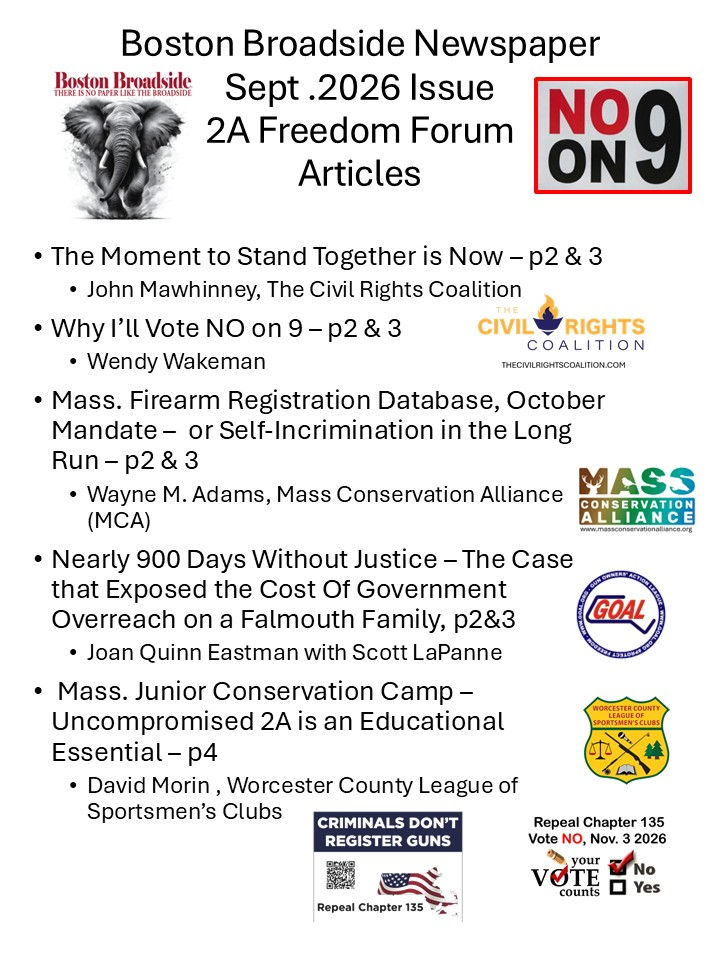
Since this is about politics, why not start a lawn sign campagn to allow people in neighborhoods across the state to put the msg literally on the street.
Too many voters are unaware of the issue and its ramnifications relative to gun owners and non gun owners.